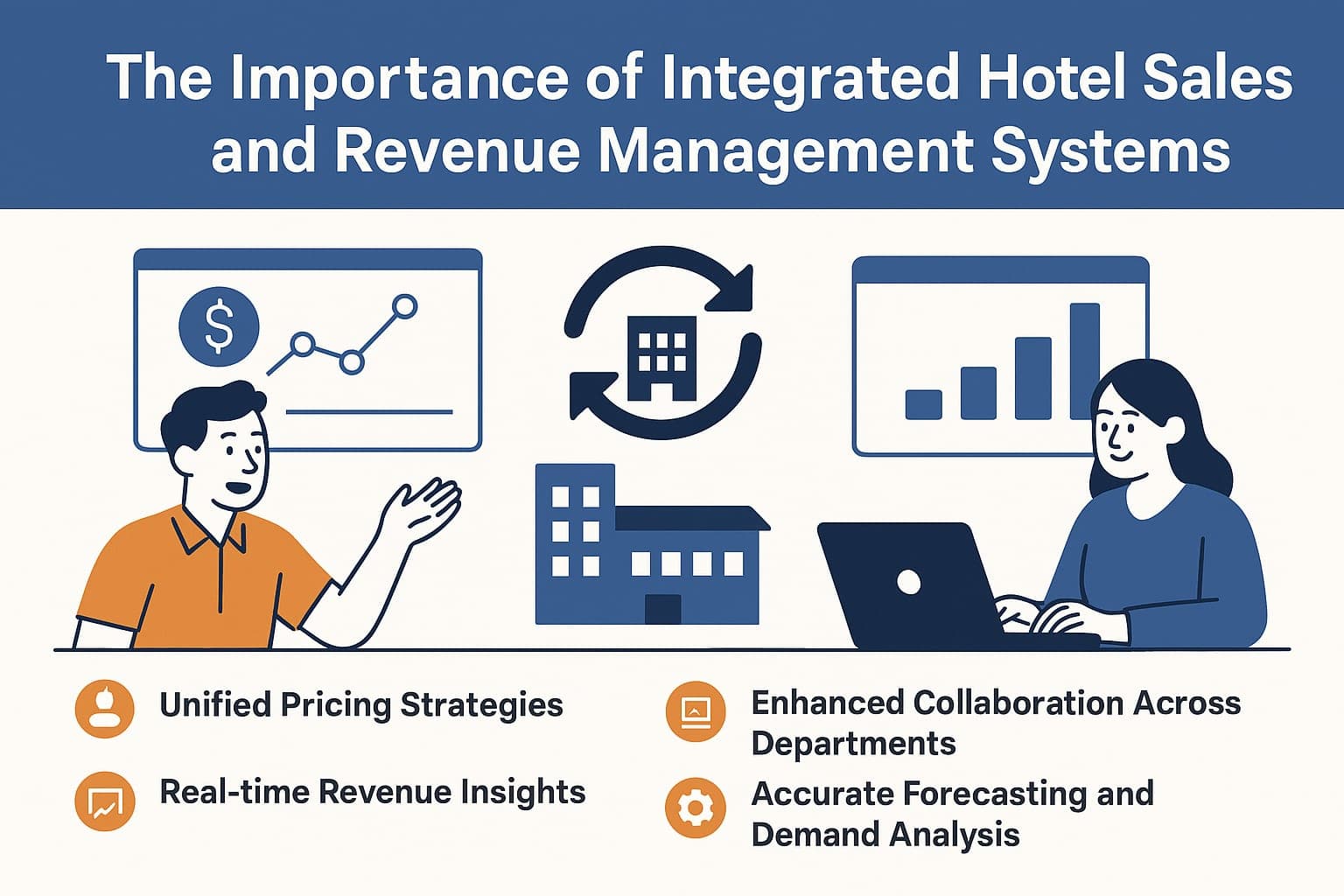
Hotel sales and revenue management do not need to use the same tool for every task. They do need a shared commercial picture. If sales is quoting from yesterday's assumptions while revenue is managing today's demand, the hotel can accept the wrong business, reject the right business, or spend hours reconciling numbers instead of making decisions.
Integration is the operating model that connects those decisions: common definitions, timely data, clear ownership, and a review cadence that turns information into action.
What sales and revenue should share
At minimum, the commercial workflow should connect:
- occupancy, ADR, RevPAR, pace, forecast, and demand signals;
- group and corporate pipeline by stage, date, room nights, and probability;
- tentative and contracted room blocks, function space, and pickup;
- rate fences, restrictions, displacement assumptions, and approval rules;
- lost-business reasons, conversion, concessions, and negotiated exceptions;
- actual performance compared with the assumptions used to quote the deal.
The goal is not to put every report in every person's hands. It is to make sure a decision uses the same dates, inventory, segment definitions, and current assumptions across departments.
Where disconnected systems create commercial friction
Sales quotes without current demand context
If sales cannot see the demand pressure around a date, a group quote may be too generous during a compression period or too rigid during a need period. Revenue then sees the deal only after the commercial terms are difficult to change.
Revenue forecasts without pipeline reality
A forecast that omits credible tentative group business understates future demand. Revenue needs visibility into stage, expected room nights, decision date, probability, and the commercial assumptions behind the opportunity—not just a total pipeline number.
Group blocks without pickup feedback
Once a block is contracted, pickup and release behavior should inform inventory and pricing decisions. If that information remains in a separate spreadsheet, the hotel can miss the opportunity to release rooms, adjust strategy, or address a shortfall early.
Manual re-entry and competing definitions
Double entry introduces timing gaps and version confusion. More importantly, teams may use different definitions of “tentative,” “on the books,” “lost,” “pickup,” or “available.” Integration work should fix the definition before automating the transfer.
A practical sales-to-revenue decision loop
Use a repeatable loop rather than relying on ad hoc meetings:
- Sense demand: revenue reviews pace, forecast, market context, compression, and need dates.
- Expose opportunity: sales sees target dates, segments, inventory, and approved commercial guardrails.
- Qualify pipeline: sales records expected rooms, function space, value, probability, decision date, and constraints.
- Evaluate the deal: revenue reviews displacement, rate, concessions, room nights, and opportunity cost.
- Approve or adjust: the owner records the decision, reason, exceptions, and expiry date.
- Monitor pickup: both teams compare contracted assumptions with actual pickup and changes.
- Learn: lost business, won business, and forecast variance update future pricing and targeting.
This loop can be supported by multiple systems if the handoffs are reliable. A single platform is not automatically integrated if users still export spreadsheets and reconcile them manually.
Data ownership matters more than data volume
Assign an owner to each important field:
| Data | Primary owner | Review question | | --------------------------------- | ------------------------------- | ------------------------------------------------ | | Forecast and need dates | Revenue | What demand or constraint changed? | | Opportunity stage and probability | Sales | What evidence supports the forecast? | | Contracted block and terms | Sales / event services | What is committed and under which conditions? | | Pickup and release | Reservations / revenue | Is actual behavior tracking the plan? | | Rate and concession guardrails | Revenue / commercial leadership | What can be offered without an exception? | | Lost-business reason | Sales | Was the loss price, product, timing, or process? | | Actual result | Finance / revenue | Did the outcome match the commercial assumption? |
Document who can edit, who can approve, how often data refreshes, and what happens when values conflict. Integration without ownership simply moves ambiguity faster.
Measure whether integration is working
Track both commercial outcomes and operating quality:
- time from inquiry to approved quote;
- percentage of quotes using current rate and demand context;
- group pickup versus contracted block;
- forecast variance for group and transient demand;
- conversion and lost-business reasons by segment;
- displacement or opportunity-cost review completion;
- rate and concession exceptions;
- data freshness and failed syncs;
- manual reconciliation hours;
- post-event or post-stay margin versus quoted assumption.
Do not attribute every revenue change to integration. Use a baseline, document major demand and pricing changes, and review whether the improved process changed decisions—not only whether a dashboard exists.
Integration readiness checklist
- [ ] Sales and revenue agree on segment, stage, pickup, and availability definitions.
- [ ] The property has a reliable source for forecast, inventory, pipeline, and actuals.
- [ ] Group opportunities include date, rooms, function space, probability, and decision date.
- [ ] Pricing and concession guardrails are visible at the point of quoting.
- [ ] Approval exceptions record owner, reason, amount, and expiry.
- [ ] Pickup and release data return to the commercial review loop.
- [ ] Failed integrations and stale data have an owner and alert path.
- [ ] The team reviews outcomes and updates assumptions on a set cadence.
A phased implementation path
Start with the highest-friction decision, not a promise to integrate everything:
- Map the current quote, forecast, contract, pickup, and reporting workflow.
- Agree on definitions and assign data owners.
- Fix the most important data-quality or timing break.
- Create a shared review view for a small set of need dates or segments.
- Add approved handoffs and exception logging.
- Measure cycle time, variance, reconciliation, and commercial outcomes.
- Expand only after the first workflow is trusted.
For hotel teams, connected commercial decisions are often more valuable than another isolated feature. Explore HotelAmplify's integrated solutions, then compare the workflow against the hotel sales software guide and hotel revenue management 101.
Frequently asked questions
What should hotel sales and revenue systems share?
Demand, forecast, inventory, group pipeline, rates, restrictions, pickup, concessions, and actual performance context are the most useful starting points.
Does integration mean replacing every hotel system?
No. A property can begin with shared definitions, reliable data exchange, and a clearer approval workflow across existing tools.
How should a hotel measure sales and revenue alignment?
Measure decision speed and data quality alongside pickup, conversion, forecast variance, rate integrity, exceptions, and the outcome of quoted business.